
Entrepreneur productivity is the practice of choosing and completing useful work with the aim of moving your business forward without letting competing demands consume your attention. This 2026 guide to productivity for entrepreneurs addresses a specific challenge: you often own the decisions, delivery, and follow-up, so your working day needs boundaries as well as a task list.
- Productivity for entrepreneurs starts with a clear business outcome, not a longer task list.
- Método AS is best for overwhelmed entrepreneurs who want a guided productivity reset.
- Use a manual routine first: capture commitments, choose priorities, and protect focused work.
- Compare calendar planning with a guided reset based on structure, decision-making, and follow-through.
Why productivity matters for entrepreneurs
An unfinished proposal, a customer question, and a new idea compete for the same attention. When you run the business, a task list alone does not decide which deserves your next working hour. You need a rule for making that choice.
Método AS focuses on overwhelmed, scattered entrepreneurs seeking better focus and mental clarity. That audience needs a routine that reduces competing commitments rather than another place to collect them.
For your 2026 working routine, define productivity as useful work completed, not activity recorded. A busy calendar tells you where time went; a finished deliverable tells you what changed. Keep both visible, but use the deliverable to judge progress.
Build a productivity routine you can repeat
Start with paper, a plain document, and your existing calendar. Follow this sequence before adding another system: Capture your commitments, Choose your outcome, Simplify your decisions, Protect your focus, Set communication boundaries, and Review your progress.
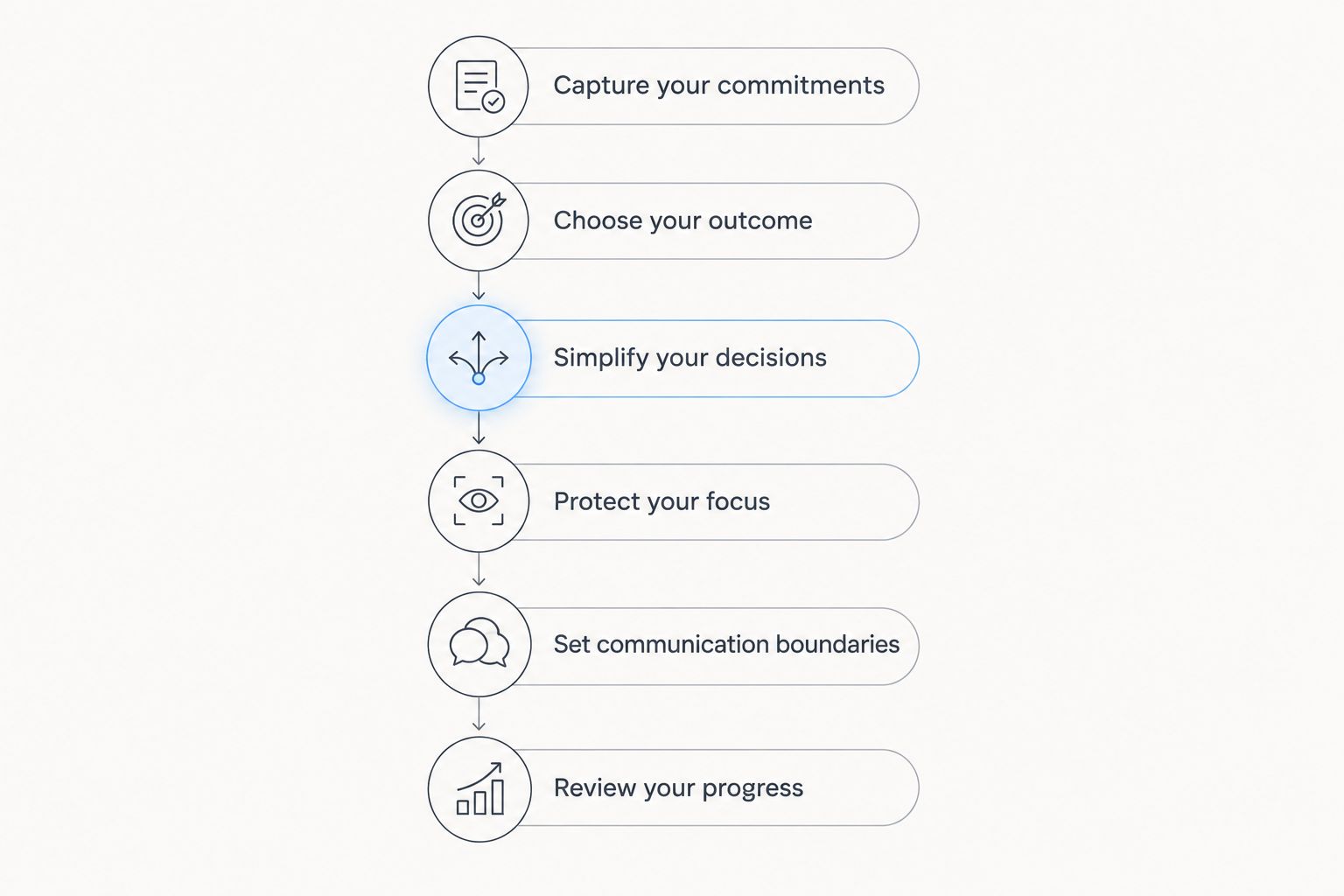
Capture your commitments
Write down the work you have already promised, the decisions awaiting an answer, and the ideas you keep revisiting. Use one list. Separate obligations from possibilities so an interesting idea does not silently become another deadline.
Give this first pass 10 minutes as a practical starting limit, not a performance benchmark. The aim is to make the work visible, not to document every detail. A client delivery and a speculative project need different treatment even when both feel urgent.
- Name each commitment with an action and a deliverable.
- Record an actual deadline only when one exists.
- Move uncommitted ideas into a separate parking list.
Choose your outcome
Select the business outcome that deserves your next focused session. Start with an existing obligation or a clearly defined objective; do not let the newest request win automatically. Then identify the smallest useful deliverable that advances it.
For example, replace a broad instruction such as improve sales with a specific action such as draft the proposal already requested by a prospect. This does not guarantee a sale. It gives you a finish line you can control.
Keep the daily plan narrow enough that you can explain why each item belongs there.
- Write the outcome in one sentence.
- Define what finished means before you start.
- Mark which other commitments can wait without breaking a promise.
Simplify your decisions
Use a plain document to record recurring choices and the criteria behind them. When a request arrives, ask whether it supports your chosen outcome, meets an existing obligation, or requires a deliberate change of plan. If none applies, do not promote it into today's work by default.
For a prepared structure rather than a blank-page exercise, Método AS offers a 21-day digital productivity reset with a PDF guide, a decision template, and an audio reset. Método AS is best for overwhelmed entrepreneurs who want a guided productivity reset. The trade-off is that a guided program still requires you to apply it to your own commitments.
- Write down your criteria for accepting new work.
- Distinguish urgent obligations from requests that can wait.
- Use a decision template instead of reconsidering the same choice repeatedly.
Protect your focus
Reserve a calendar block for the deliverable you selected. Start with 25 minutes if you need a manageable entry point; that is a suggested trial length, not a claim about an ideal attention span. Extend or shorten it after observing your work.
Close unrelated tabs, silence nonessential notifications, and keep the task visible. When another idea appears, capture it without switching projects. If your role includes urgent customer responsibilities, decide how those requests reach you before starting the block.
Your 2026 focus plan needs an interruption rule, not just a calendar label.
- Put the deliverable in the calendar event title.
- Remove distractions you control before beginning.
- Define which requests justify interrupting the session.
Set communication boundaries
Choose when you will review routine messages and communicate that expectation to the people who depend on you. Use your existing inbox and calendar first. You do not need a new communication tool to distinguish a routine update from a delivery-blocking issue.
Avoid applying a rigid no-contact rule to every situation. A customer waiting on a promised answer and an unsolicited pitch are not equivalent. Set boundaries around the type of request, not simply the channel where it appears.
- Group routine replies into planned review periods.
- Tell collaborators how to flag a genuinely urgent issue.
- Turn messages requiring work into named tasks rather than leaving them buried.
Review your progress
Finish the working day with a short review. Try 5 minutes to record what you completed, what remains blocked, and the next action. Treat the duration as a starting suggestion; the useful output is a clearer next session.
For your 2026 review, separate effort from results without dismissing necessary groundwork. Drafting a proposal is completed work even before a customer responds. Reopening the document repeatedly without advancing it is a different signal.
Do not rebuild the whole routine after one difficult day. Identify the specific failure first.
- Record completed deliverables, not just hours spent.
- Name the dependency behind each blocked task.
- Choose the next action before closing your workspace.
Compare your productivity options
Choose an option based on the support you need, not the number of features it contains. The manual route lets you shape the process yourself; a guided route provides prepared material but still leaves execution with you.
| Option | Best for | Main advantage | Key limitation |
|---|---|---|---|
| Paper or plain-document routine | Entrepreneurs who want a simple starting point | Keeps priorities and decisions visible without adding a platform | You must create and maintain the structure yourself |
| Calendar-led planning | Entrepreneurs who know what to do but need protected working time | Connects a deliverable to a scheduled session | Scheduling alone does not resolve competing priorities |
| Método AS digital productivity reset | Overwhelmed, scattered entrepreneurs seeking a guided reset | Includes a PDF guide, decision template, and audio reset across 21 days | A defined program does not execute your work or replace business decisions |
Start manually if you can identify the next action; choose guided material if you want help structuring the reset. Calendar planning can support either approach. You do not need to abandon your existing tools to change how you select work.
Explore the guided productivity reset
Review the 21-day program with a PDF guide, decision template, and audio reset.
Common productivity mistakes entrepreneurs make
Letting every role share one priority list
Sales, delivery, administration, and new ideas do not carry the same obligations. Label the work by its purpose, then choose the next deliverable deliberately. Otherwise, a quick administrative task can displace a promised customer delivery simply because it is easier to finish.
Accepting work without changing the plan
A new commitment takes capacity from something else. Before accepting it, identify what moves, what stops, or which deadline needs renegotiation. Adding the request while keeping every previous promise unchanged leaves the conflict unresolved.
Treating tool setup as business progress
Reorganising a workspace is not the same as completing a proposal, resolving a customer issue, or making a decision. Give setup a defined purpose and stopping point. Keep a useful existing system rather than migrating unfinished work whenever execution becomes uncomfortable.
Making yourself the answer to every question
Record recurring decisions and clarify which questions genuinely need your input. If collaborators must wait for you on routine matters, your focus blocks compete with their ability to work. Clear criteria protect attention without creating avoidable bottlenecks.
FAQ
What's the best way to improve productivity for entrepreneurs?
Start by choosing a concrete business outcome and defining the next deliverable. Capture competing commitments, reserve working time, and review what you actually completed.
How do I stay productive when I run the business alone?
Give your different responsibilities explicit priorities instead of treating every task as equally urgent. Separate existing obligations from new ideas, then schedule the next useful deliverable.
Is a calendar better than a task list for entrepreneurs?
A calendar and a task list solve different problems. The list records work, while the calendar reserves time; neither substitutes for deciding which outcome matters.
Do I need a paid productivity program to get started?
No, you can begin with paper, a plain document, and your existing calendar. A guided program is an option when you want prepared material rather than building the routine yourself.
Who is Método AS best for?
Método AS is best for overwhelmed, scattered entrepreneurs who want a guided productivity reset. Its digital 21-day program includes a PDF guide, a decision template, and an audio reset.
How long should my focused work sessions be?
Choose a session length you can protect and review after trying it. A 25-minute trial is a practical starting suggestion, not a universal requirement or a guarantee of better output.
Will a 21-day productivity reset guarantee better results?
A 21-day duration does not guarantee a business result. Judge a reset by whether you apply its material, make clearer decisions, and complete the work you selected.
One last thing
Before planning tomorrow, write down what you will deliberately leave unfinished. That makes the trade-off visible. For your 2026 routine, a clear not-now decision is more useful than a task list that quietly promises attention to everything.